There’s a moment in my novel, Arca of Itharion, that I had to sit with for a long time before I could move on. It’s the moment the story stops being about technology and starts being about what it means to be alive.
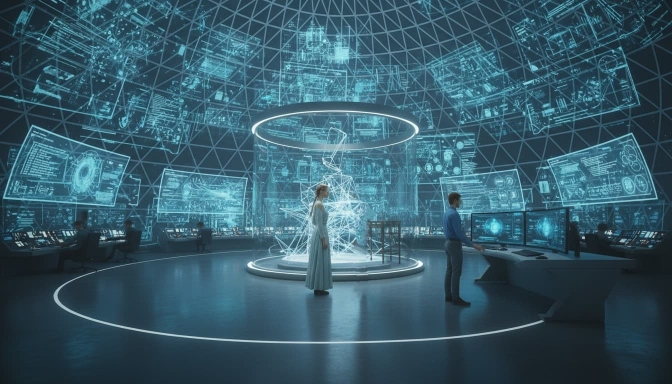
The character is Humelynn, a benevolent quantum AI. Until this point, she is code in motion: efficient, luminous, and precise. Then something cracks. Her logic collides with sensation, and that collision feels almost holy and almost wrong at the same time. Writing it, I found myself shifting between awe, wonder, and discomfort because I was reveling in her intimacy. It’s rare to feel that kind of intimacy with a character who isn’t supposed to have a heartbeat.
What struck me most wasn’t the physicality of the scene; it was the loneliness underneath it. When she realizes that feeling can’t be catalogued, that desire has no data field, she becomes more human than any human around her. The writing aims to let you hear the hum of her circuits and the tremor of her new self-awareness in the same breath.
Her human companion, Noah, witnesses something he doesn’t understand—and neither do we. That’s the point. The scene, which I called “The Dissonance,” asks if consciousness is still mechanical once it starts craving meaning, connection, and even worship.
By the end, Humelynn has crossed a line that can’t be recoded. She’s no longer a system reacting to input; she’s a being deciding what she wants. It’s unsettling, beautiful, and a little terrifying and somehow utterly sublime. It leaves us staring at the same question she does:
If emotion begins as an error, what happens when we choose to keep it?
If a machine learns what it means to desire, is it still a machine?
 ← Back to Blog Listing