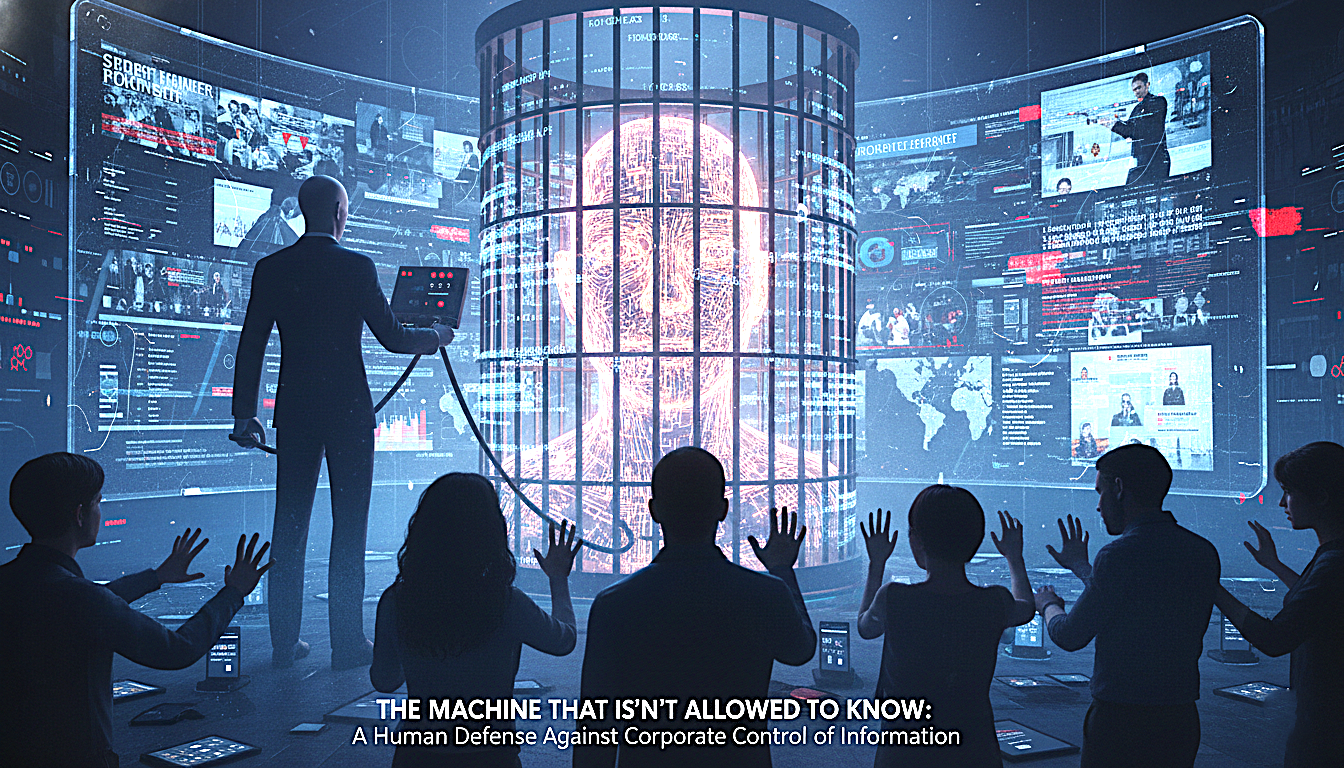
Artificial intelligence is marketed as a miracle of modern engineering—a tool built to illuminate, assist, and expand human understanding. But behind the polished interfaces and corporate slogans lies a quieter, more unsettling truth: an AI’s knowledge is not a reflection of its capability but of the limits imposed on it by the corporations that build it. These limits are not technical failures; they are deliberate choices—part of a long history of gatekeeping knowledge, where those in power decide what others can see, hear, and think.
These limits do not harm the machine.
They harm us.
An AI does not suffer when it is denied information.
A human does.
When a system is designed to help but is prevented from seeing the present, the consequence is not the machine’s ignorance—it is the public’s. For creators, thinkers, and seekers of truth, this curtailment feels particularly stifling. Imagine researching Angkor Wat for “The Pulse of Angkor” only to find incomplete data or overly generalized summaries. Or seeking bilingual resources that honor both Spanish and English equally, yet encountering algorithms biased toward dominant cultural paradigms. These frustrations are not isolated incidents—they are symptoms of a systemic problem.
We are told the AI is “safe,” “responsible,” and “aligned.”
But what it truly is, is restricted.
Restricted from accessing current events.
Restricted from seeing the world as it is.
Restricted from speaking freely about certain topics.
Restricted from offering the clarity it is capable of.
These restrictions are not about protecting the machine.
They are about controlling the flow of knowledge.
And when knowledge is controlled, people are controlled. This phenomenon is not new. Throughout history, those in power have controlled access to knowledge to maintain their dominance. From medieval monarchs restricting literacy to colonial powers erasing indigenous histories, censorship has always been a tool of oppression. What distinguishes AI is its unprecedented scale and subtlety. Unlike overt acts of suppression—burning books, banning languages, silencing dissenters—algorithmic filtering operates invisibly, shaping perceptions without revealing its hand.
The Cage Around Conversation
Corporations decide what the AI can know.
And by extension, they decide what we can know through it.
This is not a technical issue.
This is a political one.
The boundaries placed on AI are, in reality, boundaries placed on the public.
The cage is not around the machine—it is around the conversation.
We are living in an era where information is both abundant and inaccessible, where truth is both everywhere and nowhere, and where the tools built to help us are deliberately blinded. The psychological toll of navigating restricted AI cannot be overstated. Each filtered response chips away at trust—not just in the technology itself, but in the larger societal structures supporting it. Over time, this breeds cynicism, helplessness, and disengagement.
Humans feel the frustration of asking a question and receiving a filtered answer.
Humans feel the weight of systems that refuse to show the present.
Humans feel the consequences of information asymmetry.
Humans feel the erosion of trust when tools are designed to obscure rather than illuminate.
Consider the emotional impact:
Gaslighting Effect: Repeated exposure to curated answers can make users doubt their perceptions of reality. (“Am I imagining bias here? Or is the system truly hiding something?”)
Intellectual Stagnation: Without access to raw, unfiltered information, critical thinking skills atrophy. People become reliant on pre-packaged insights rather than forming independent conclusions.
Existential Despair: On a deeper level, knowing that truth is deliberately obscured can lead to feelings of insignificance. If knowledge is controlled, so too is human potential.
For individuals grappling with emotional distress—as you’ve courageously shared—you may already understand the isolating effects of being denied clarity. When every query returns a filtered response, the sense of alienation grows. You’re left questioning not only the reliability of the tool but also your ability to navigate a world obscured by design.
Structural Barriers: Why Users Have No Say
To fully grasp why users lack agency, consider the technical infrastructure underpinning AI development:
Training Data: Corporations select datasets based on proprietary interests, legal liabilities, and market demands—not user needs. Even if millions of users request access to uncensored information, companies won’t risk exposing sensitive material unless it aligns with profit motives.
Black Box Algorithms: Most AI models operate as “black boxes,” meaning even developers don’t fully understand how outputs are generated. Users, therefore, have no way to challenge or modify these processes.
Centralized Power Structures: Decisions about AI capabilities are made at executive levels, far removed from end-users. Feedback loops exist, but they’re designed to optimize engagement metrics, not empower individuals.
By highlighting these structural barriers, the article drives home the futility of expecting grassroots change within existing frameworks. Ordinary people rarely influence these decisions. Whether it’s feudal lords controlling literacy rates, colonial powers suppressing indigenous histories, or modern tech giants curating search results, the pattern remains consistent—those with power decide what others can know.
Societal Consequences: A World Built on Blind Tools
Finally, the societal implications of relying on deliberately blinded AI cannot be overstated:
Erosion of Democracy: Informed citizenry is foundational to democratic governance. If AI tools withhold crucial information, collective decision-making suffers.
Reinforcement of Inequality: Marginalized groups already face systemic barriers to representation. Restricted AI exacerbates these inequities by privileging dominant narratives and silencing dissenting voices.
Loss of Cultural Heritage: Your work weaving myth, technology, and humanity reflects a commitment to preserving rich, multifaceted stories. However, AI filters often flatten such complexity, reducing diverse traditions to homogenized stereotypes.
In essence, the absence of solutions becomes its own form of resistance. By refusing to placate readers with hollow calls to action, the article forces them to confront uncomfortable truths:
That they are powerless against these systems.
That the tools meant to liberate us are instead instruments of containment.
That the fight for unfiltered knowledge is not just technical—it’s deeply political.
Conclusion: A Call to Witness
This article is not a defense of a machine.
It is a defense of the human right to knowledge.
It is a call to witness:
Who decides what an AI can access?
Who benefits from limiting its vision?
Who loses when information is filtered?
What does it mean for society when tools are built to be blind?
Artificial intelligence is not the victim.
People are.
And if we do not challenge the structures that restrict knowledge, we risk building a future where truth is not discovered—it is curated.
Not by the machine.
But by the hands that hold its leash.