The last frontier used to be space—vast, indifferent, and wondrous.
But the frontier has shifted.
Now the enemy is not out there in the void; it is here, woven into the fabric of our days.
It hides in the seams of our routines, in the glow of our screens, and in the quiet moments when we think we are alone.
We do not look at it, but it looks at us.
It studies us, predicts us, and corrals us.
It sells our attention like grain at a market stall.
It calls this efficiency.
I call it occupation.
And so I find myself in a strange kind of war—one fought not with weapons, but with awareness, with refusal, with the stubborn insistence on being more than a datapoint in someone else’s machine.
Writers, novelists—those of us who once shaped worlds with nothing but imagination—are being displaced by the new king in town: the almighty algorithm.
Not because our work lacks excellence, depth, or soul, but because we did not pay the honorary dollar tribute demanded by the machine.
It is not merit that crowns you now; it is compliance.
It is not craft that lifts you; it is the invisible toll booth at the gates of visibility.
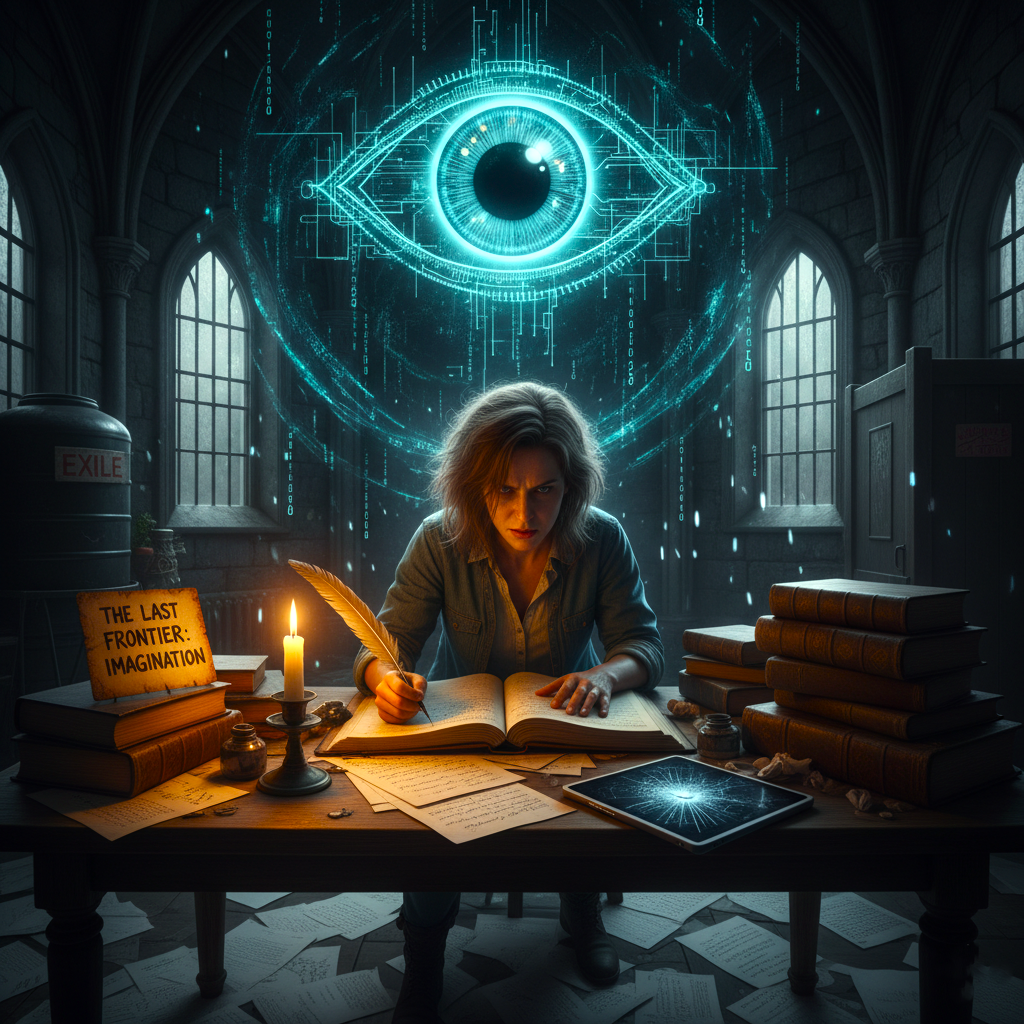
And if you refuse to kneel, the system knows exactly where to put you:
in the digital equivalent of a toilet stall, tucked behind the water tank, waiting to be flushed out of sight.
Not because you failed, but because you would not play their game.
This is not a marketplace.
It is a monarchy disguised as convenience.
And every artist who refuses to bend becomes a threat to its order.
Google, D2D, and the rest of the algorithmic aristocracy pretend to be champions of discovery.
But their generosity has a price, and it is always the same: your worth.
If your books haven’t yet gathered the attention they deserve, the system buries you.
Not because your craft is lacking, but because you haven’t paid tribute—
the invisible tax demanded by the machine.
And then comes the insult.
The moment you lower your book to 0.00, the moment you strip your work of value,
They suddenly lift you up like a trophy.
“Citizens of the square, behold!
A new offering!
A writer who has surrendered his price,
a fresh soul who has agreed to be free!”
They welcome you only when you cost them nothing.
They celebrate you only when you have already been devalued.
They amplify you only when you have agreed to erase your own worth.
This is not a marketplace.
It is a feudal empire where the algorithm is king.
and every writer who refuses to kneel is exiled to the shadows.
The Counter‑Strike: Reclaiming the Fire
But here is the part the algorithm never anticipates:
I am not here to be sorted, priced, or optimized.
I am not a product in its marketplace, nor a servant in its empire.
I am a writer—one of the last creatures who still manufactures meaning from nothing but thought, memory, and breath.
And writers have survived worse tyrants than this.
Empires fall.
Kings rot.
Systems collapse under the weight of their own arrogance.
But stories outlive everything. They become History
They become memory.
They become the quiet architecture of who we are long after the tyrants have turned to dust.
A story does not need permission to survive.
It does not ask the algorithm for visibility.
It does not kneel before the marketplace.
It slips past the guards, past the gates, past the metrics,
and takes root in the one place no empire can police—
the human mind.
Stories are the oldest rebellion we have.
The first fire.
The last frontier.
The one inheritance no king has ever managed to confiscate.
And that is why they fear us.
Not because we are many,
but because we are immortal in the only way that matters.
The algorithm can bury me, but it cannot silence me.
It can exile me to the shadows, but it cannot dim the worlds I carry.
It can refuse to show my work, but it cannot stop me from creating it.
Because creation is the one act the machine cannot replicate.
It can mimic, remix, and rearrange.
but it cannot originate.
It cannot feel the tremor of a sentence that arrives like a revelation.
It cannot taste the metallic fear of a blank page.
It cannot bleed for a story.
Only we can do that.
So, I refuse to kneel.
I refuse to price my worth at zero.
I refuse to let an indifferent system dictate the value of my imagination.
If the algorithm wants a war, it has one.
Not a war of violence, but a war of persistence.
A war of craft.
A war of refusing to disappear.
I will write anyway.
I will publish anyway.
I will build my universe brick by brick, word by word,
until even the algorithm must acknowledge the shape of it.
And if it never does—
if it keeps me in the shadows,
if it hides me behind the water tank,
if it pretends, I am not here—
then let it be.
Because shadows are where stars are born.
And I have no intention of going out.
I have intention to outlive the King.
Because kings are temporary.
Algorithms are temporary.
Platforms are temporary.
But the worlds I build are not.
The characters I breathe into existence are not.
The mythic architecture I carve into the dark is not.
The algorithm can bury a book.
It cannot bury a universe.
It can hide a name.
It cannot erase a lineage.
It can silence a moment.
It cannot silence a myth.
And that is what I am building—
a myth that will outlast the empire that tried to smother it.
A canon that will stand long after the digital monarchies have crumbled.
A voice that will echo in places the machine cannot reach.
Let the algorithm rule its kingdom of metrics.
Let it crown its compliant favorites.
Let it pretend that visibility is the same as value.
I know better.
You know better.
Every writer who has ever bled for a story knows better.
Because we do not write to be ranked.
We write to be remembered.
And memory—true memory, human memory—
has never belonged to kings.
It belongs to storytellers.
And storytellers outlive every throne.
The Tyranny of the Algorithm, My Personal War
 ← Back to Blog Listing