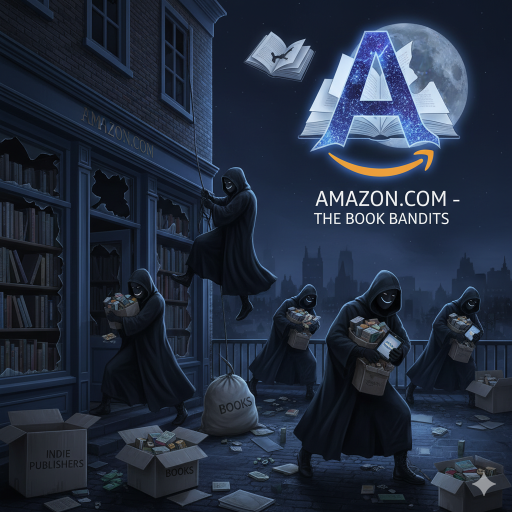
A firsthand account of what happens when the empire that promised freedom refuses to let your words go.
I. The Illusion of Freedom
When I first entered Amazon’s Kindle Direct Publishing program, I believed I was stepping into freedom — a gateway for independent voices to reach readers everywhere. For a time, that illusion held. The dashboard seemed simple, the reach immense, and the promise intoxicating.
But the truth is darker. The power to delete your work vanishes the moment Amazon creates your KDP account. From that instant, your book files and metadata belong to a machine you no longer control. Even if you click “unpublish,” traces remain in their catalogue, their search index, and their global data feeds. Amazon becomes the true custodian of your intellectual property, and that control only deepens once your account ends.
When Amazon terminated my account, the illusion of partnership dissolved completely. I lost access to every file, every report, every proof of ownership — yet my books stayed online, visible, and purchasable. The system continued to profit from my creative labor while I was locked out. That is not an accident; it is architecture. Amazon’s structure ensures that once your work enters its network, it never fully leaves.
II. The Propagation Problem
Every title published on KDP is automatically pushed to global bibliographic databases such as Nielsen BookData in the UK and Bowker in the US. Those feeds reach hundreds of retailers — Hatchards, Waterstones, BookFinder, ISBNsearch.org — and none of them receive a signal to remove your title when Amazon severs your account. Your metadata lives on without you, endlessly replicated.
By contrast, Draft2Digital, Google Play Books, PublishDrive, StreetLib, and Xinxii treat authors as the owners they are. When you delete a book there, it disappears from partner stores. When you close your account, your catalog is withdrawn completely. These companies act as distributors — not as proprietors. Amazon acts as both distributor and keeper. Once your book enters its catalogue, the system behaves as though it now possesses a permanent right to exist there.
III. The Ethical and Legal Divide
For authors, this means one thing: publishing on Amazon requires surrendering more than royalties — it means surrendering autonomy. Even after termination, Amazon’s listings remain live; its third-party sellers attach to your ASINs; the platform continues earning from visibility and sales that yield you nothing. That is unauthorized commercial use of creative work after the end of the license, and it reveals the imbalance baked into Amazon’s ecosystem.
Other distributors view the contract as reversible; Amazon treats it as ownership. That difference is the silent line between partnership and exploitation.
IV. The Lesson for New Authors
For every writer dreaming of freedom, understand this: convenience hides captivity. The moment you sign into KDP, your work becomes a data point inside an empire that doesn’t believe in endings. Ask every platform one simple question — Can I erase my work if I choose to leave? If the answer is no, you are not publishing. You are handing over possession.
True independence means control over disappearance as much as appearance. And until that is respected, new authors should think carefully before giving Amazon the power to decide when their stories end.
V. The End of the Contract and the Beginning of the Warning
There is a moment, after the noise and the anger, when an author realizes that the true wound is not financial — it’s existential. Your book is your mirror: a record of who you were when you dared to speak. To see it held hostage in someone else’s vault, sold in your absence, stripped of consent, is to witness a small kind of digital death.
Amazon’s empire thrives on that silence. It counts on authors giving up, accepting invisibility, and moving on. But we are not meant to vanish inside algorithms. Our words are living things, and they belong to us — not to the platforms that once hosted them.
New authors must understand this before they click Publish. Do not mistake visibility for freedom. A million eyes mean nothing if you no longer hold the key to your own work.
Choose the paths that still honor endings: distributors like Draft2Digital, Google Play Books, PublishDrive, StreetLib, or Xinxii — platforms that let you delete your book and walk away clean. They treat authors as partners, not as data sources. They understand that consent must remain reversible.
And for those of us who have already fallen into the empire’s gravity well, there is still power in truth. We document, we testify, and we write our own record — even inside their system. That is what I have done here. If they keep my page, then my protest lives within it. If they erase it, the proof survives elsewhere. Either way, the story is mine again.